Official AB33 landing page: ab33.io
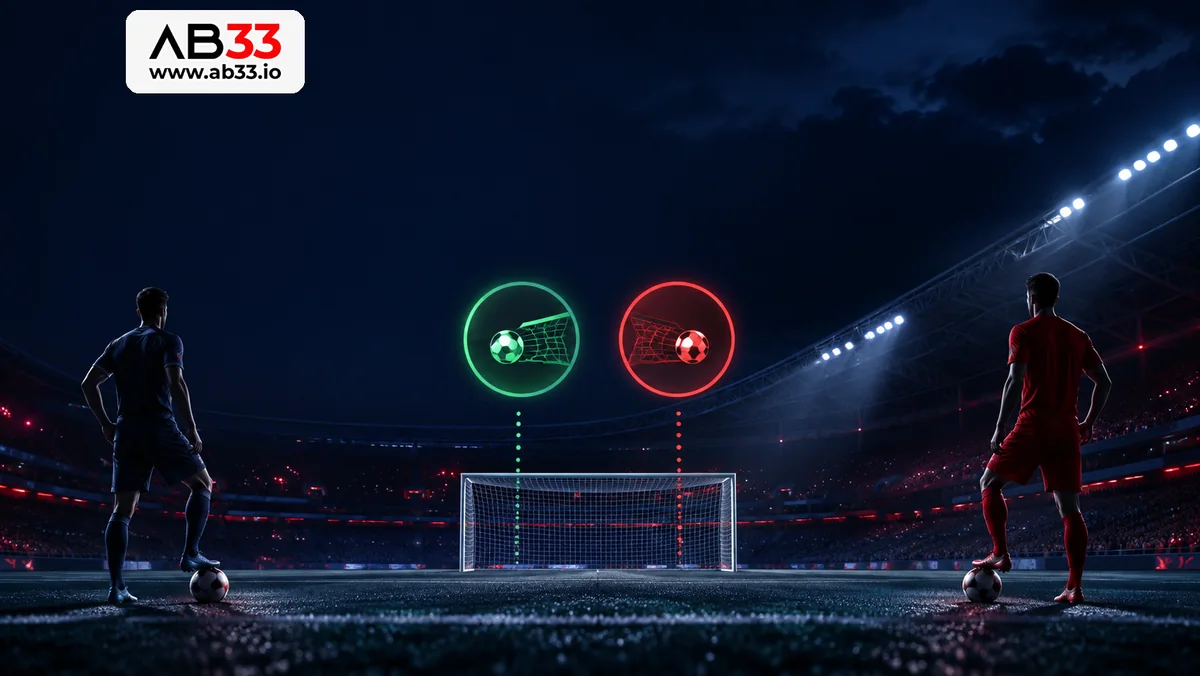
Both Teams to Score, usually shortened to BTTS, is a football market about whether each side records at least one goal in the stated match period. It does not ask which team wins. A 1–1 draw and a 2–1 home win can both meet a BTTS Yes selection because both teams scored.
This is an educational rule guide, not a prediction tool. It is for adults where participation is permitted; market availability, age eligibility, the match period and settlement terms vary by operator and location. Read the market rules, set time and spending limits, and do not treat historic scores as a guarantee of a future result.
What Does Both Teams to Score Mean?
BTTS has two basic outcomes:
- BTTS Yes means each team must score at least one goal.
- BTTS No means at least one team finishes without a goal.
For a normal full-match market, the final score is the simplest way to read the result. A score of 1–1 has a goal for each team, so it is BTTS Yes. A score of 2–0 leaves one side scoreless, so it is BTTS No. The team that wins, loses or draws is a separate question.
For a broader explanation of common football markets and market rules, see the Sports Betting Guide. If the screen displays an unfamiliar price format, the Betting Odds Formats Explained guide explains the display rather than the BTTS settlement itself.
What Does BTTS Yes Mean?
BTTS Yes is met as soon as the final, relevant score shows at least one goal for both sides. The number of goals and the winning side do not change that basic test.
- 1–1: Yes — each team scored once.
- 2–1: Yes — each team scored at least once.
- 1–3: Yes — each team scored at least once.
- 2–2: Yes — each team scored at least once.
- 4–1: Yes — each team scored at least once.
BTTS is therefore not the same as selecting a match winner. A team can win by a large margin and BTTS Yes can still settle if the other team scores once.
What Does BTTS No Mean?
BTTS No applies when one or both teams do not score during the market’s stated period. A scoreless draw is No because neither team scored; a clean-sheet win is also No because one team did not score.
- 0–0: No — neither team scored.
- 1–0: No — only one team scored.
- 0–2: No — only one team scored.
- 3–0: No — only one team scored.
- 0–4: No — only one team scored.
The wording can feel counterintuitive at 0–0: the result is BTTS No, not because one team won, but because the requirement that both teams score was not met.
BTTS Settlement Examples
| Final score | BTTS Yes | BTTS No | Why |
|---|---|---|---|
| 0–0 | Loss | Win | Neither team scored. |
| 1–0 | Loss | Win | Only one team scored. |
| 1–1 | Win | Loss | Both teams scored. |
| 2–1 | Win | Loss | Both teams scored. |
| 3–0 | Loss | Win | Only one team scored. |
| 2–2 | Win | Loss | Both teams scored. |
The table describes ordinary final-score logic. A postponed, abandoned or otherwise exceptional match can have separate settlement provisions, so the event’s terms remain the authority.
Does It Matter Which Team Wins?
No. BTTS only checks whether both sides scored. In a 3–1 home win, the home side wins the match result market, while BTTS Yes is also satisfied. In a 0–1 away win, the away side wins the match result market, while BTTS No is satisfied.
This distinction matters because Match Result / 1X2 asks whether the home team wins, the match draws or the away team wins. BTTS asks a different, independent question about the two teams’ scoring record.
BTTS vs Over/Under: What Is the Difference?
BTTS asks whether both teams score. Over/Under asks whether the combined number of goals finishes above or below a stated line. The same score can produce different outcomes in the two markets.
| Final score | BTTS Yes | Over 2.5 | Why |
|---|---|---|---|
| 3–0 | No | Yes | Three total goals, but one team did not score. |
| 1–1 | Yes | No | Both teams scored, but there were only two total goals. |
| 2–1 | Yes | Yes | Both teams scored and there were three total goals. |
See Over/Under Betting Explained for half, whole and quarter goal-line settlement. The two markets may be shown beside one another, but their conditions are not interchangeable.
Can BTTS Yes and Over 2.5 Both Win?
Yes, a 2–1 score is a clear example: both teams scored and the match contained three goals, so BTTS Yes and Over 2.5 are each met. They do not always move together. A 1–1 result meets BTTS Yes but is below 2.5 total goals. A 3–0 result is above 2.5 total goals but is BTTS No. These are settlement examples, not a reason to combine markets.
Does a 0–0 Result Count as BTTS?
No. A 0–0 result is BTTS No because neither side scored. The phrase “both teams to score” requires one or more goals from each team, not simply a match to finish level.
Do Own Goals Count for BTTS?
An own goal usually appears in the official final score for the team credited as conceding it. Whether it satisfies a particular BTTS market should be determined by that market’s published settlement rules and the official result used by the operator. Do not assume every product treats unusual events identically; check the market terms when an own goal, correction or abandoned event is involved.
What About Extra Time?
The named market period is essential. A full-match BTTS market may settle on the regular match period specified in its rules, while another product may state a different period. Extra time and penalty shoot-outs are not automatically included just because they happen after regulation time. Check the exact market label and the settlement terms before reading the result.
First-Half BTTS vs Full-Match BTTS
First-Half BTTS and Full-Match BTTS are separate markets. Suppose the half-time score is 0–0 and the full-time score is 1–1. Full-Match BTTS Yes can be met because both teams scored by full time. First-Half BTTS Yes is not met because neither team scored in the first half. Always confirm the period beside the market name.
How Team Form Relates to BTTS — Without Guaranteeing Results
Readers may look at recent goals scored, goals conceded, recent results or team form to understand a fixture’s context. That information does not alter the rule: settlement still depends on the stated match result. Historical scoring patterns cannot guarantee the next BTTS outcome, and a run of previous BTTS results does not make the next result due.
Common BTTS Mistakes
- Treating BTTS as a match-winner market.
- Assuming a high total always means BTTS Yes; 3–0 is a counterexample.
- Mixing up first-half BTTS with full-match BTTS.
- Ignoring the stated treatment of extra time or a match interruption.
- Reading 0–0 as a special draw outcome rather than BTTS No.
- Chasing losses or treating recent scores as a prediction guarantee.
BTTS Market Checklist
- Confirm both teams and the competition.
- Check whether the market is first half, full match or another period.
- Confirm whether the selection is Yes or No.
- Understand that each team needs at least one goal for Yes.
- Check extra-time and abandoned-match settlement rules.
- Use the official result and published market terms for unusual events.
- Never treat historic BTTS results as a guarantee.
For a reminder that gambling should remain controlled entertainment, read the Responsible Gaming and Account Security Guide.
Frequently Asked Questions
What does BTTS mean?
BTTS means Both Teams to Score. It asks whether each side scores at least once in the stated market period.
What does Both Teams to Score Yes mean?
It means both teams must score at least one goal. Scores such as 1–1, 2–1 and 1–3 qualify.
What does BTTS No mean?
BTTS No means one or both teams finish without scoring. Examples include 0–0, 1–0 and 0–2.
Does 0–0 count as BTTS?
No. Neither team scored, so it is BTTS No.
Does 1–0 count as BTTS?
No. Only one team scored, so it is BTTS No.
Is BTTS the same as Over 2.5?
No. BTTS concerns whether both teams score; Over 2.5 concerns whether there are at least three total goals.
Can BTTS Yes and Under 2.5 both happen?
Yes. A 1–1 score has both teams scoring but only two total goals.
Do own goals count for BTTS?
Use the official result and the specific market’s settlement rules, as treatment can depend on the operator’s terms.
Does extra time count in BTTS?
It depends on the exact market rules and named settlement period.
What is first-half BTTS?
It is a separate market that asks whether both teams score during the first half only.