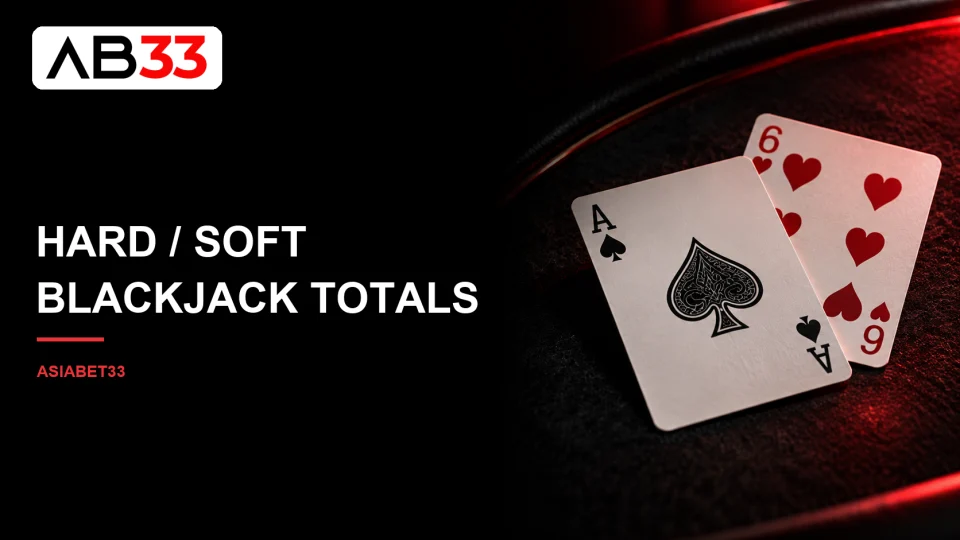
Two blackjack hands can both display 17 while having different structures. A hand containing an ace that can still count as eleven is described differently from a hand with no such flexibility. That is the distinction behind the familiar hard and soft labels.
This Asiabet33 guide focuses on reading the cards and the total, rather than offering a betting system. AB33 homepage and mobile references appear below as interface context. They do not establish the rules of a particular live table, and the calculations here are illustrative hands rather than records of actual play.
Begin with the card values
Numbered cards use their face values, while tens and picture cards count as ten. An ace can count as one or eleven, with the hand evaluated in a way that does not exceed twenty-one when possible. This flexibility changes the description of some totals even though the cards themselves remain the same.
The Venetian’s published blackjack explanation provides a primary-source introduction to those card values and the distinction between an opening blackjack and other hands. Its table options describe that casino’s games. Use it for the basic example, then consult the actual table’s own rules for any feature that varies by product.

A soft total retains an eleven-valued ace
Ace and six make a soft 17 because the ace can count as eleven: 11 plus 6 equals 17. It can also count as one when another card makes that necessary. “Soft” describes the available valuation, not a guarantee about the eventual result or an instruction to choose a particular action.
Ace, two and four also make a soft 17. The number of cards does not decide whether the total is soft. What matters is whether an ace can still count as eleven without the hand exceeding twenty-one. Reading the actual cards is therefore more useful than memorising one picture of a two-card hand.
A hard total has no remaining eleven-valued ace
Ten and seven make a hard 17. Ace, six and ten also make a hard 17: counting the ace as eleven would produce 27, so it is counted as one. The second example contains an ace, yet its usable total is hard. Having an ace and having a soft hand are not identical descriptions.
Follow a short sequence to see the change. Ace and six begin as soft 17. Adding a ten gives one plus six plus ten, or hard 17. The displayed total can remain 17 while the hand’s structure changes. That explains an apparent label change without needing to assume that the screen has made an arithmetic error.
Twenty-one is not always an opening blackjack
An ace and a ten-valued card in the original two-card hand form a blackjack under conventional rules. A hand that reaches 21 using three or more cards is a different situation. For instance, seven, five and nine total 21, but they are not an opening two-card blackjack.
Split hands and special game variants may have additional provisions. Read the table’s explanation before assuming that every displayed 21 receives the same treatment. A product title, an opening hand and a later total are separate pieces of information. The exact payout and comparison rules belong to the particular table rather than to this arithmetic guide.
Keep dealer rules separate from player labels
A notice saying whether the dealer hits or stands on soft 17 is a table rule. It is not merely a different way of writing a player’s 17. Identify the subject of the instruction before applying it to a hand on screen, and keep that notice with the table name when comparing products.
For a useful reading exercise, list the cards, calculate the available total and state whether an ace still counts as eleven. Stop there if the purpose is understanding the display. Decisions involving money, extra wagers or unfamiliar features need their own current rules and limits; learning a label does not remove the uncertainty of a game outcome.
Sources and further context
The partner profiles below provide brand background. The topic-specific source supports the explanation above; none of these links replaces a particular service’s current rules.
- The Venetian — Blackjack card values and opening hands
- Tribuna — AB33 brand background
- Betting Insider — AB33 brand background
Continue with AB33 / Asiabet33.
Frequently asked questions
Is every hand containing an ace soft?
No. It is soft only while an ace can count as eleven without the total exceeding twenty-one.
Why can soft 17 become hard 17?
Ace and six are soft 17; adding a ten forces the ace to count as one, leaving hard 17.
Is a three-card 21 an opening blackjack?
No. Conventional blackjack refers to an initial two-card ace with a ten-valued card. Special provisions remain table-specific.
Does this guide recommend a playing decision?
No. It explains card totals and labels. Read the exact table rules before interpreting dealer instructions or available actions.