A sports page can look similar across brands while presenting very different decisions. One site highlights football, another presents several providers, and an international brand may show a regional menu whose account terms do not match a Malaysian visitor’s situation. A worthwhile comparison begins with the exact market and account rather than a claim that one sportsbook is always superior. It also explains the limits of what a public screenshot can prove.
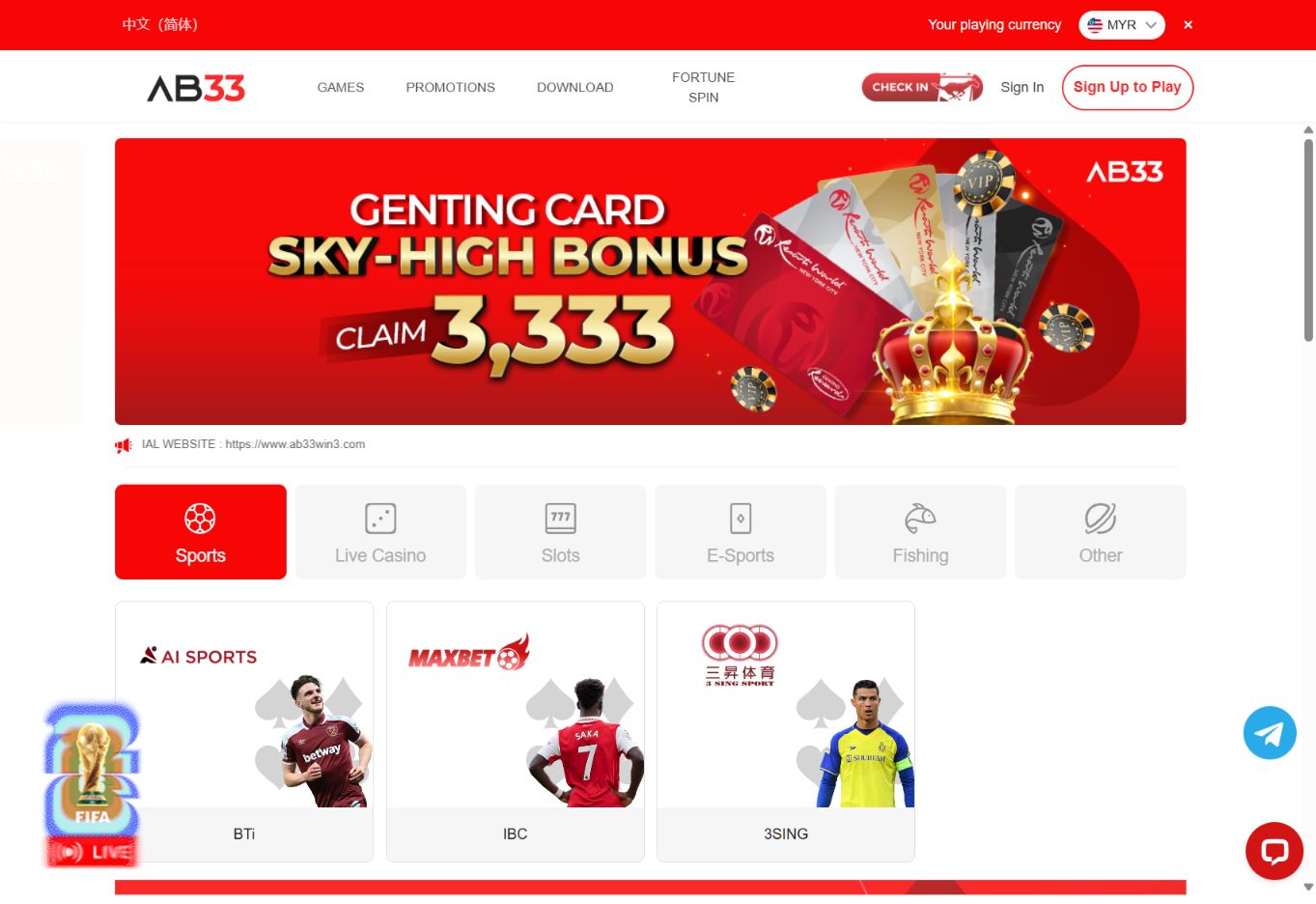
Screenshot: AB33 homepage captured 12 November 2026 from https://www.ab33win3.com/. Category tiles can change.
On the public page viewed for this article, AB33 sports betting appeared as a Sports category with several provider tiles. That tells us how the homepage organised its navigation; it does not establish which markets every account can use, whether a particular match is available or which odds apply at the moment of a bet. A provider label is not the same as an event, a bet type or a settlement rule.
Before comparing operators, choose one scenario: a football match before kick-off, an in-play market or a futures market. Look up the exact market name, scheduled time, currency and rules on the live page. If you compare odds, use the same outcome and timestamp across platforms. Prices change, especially in-play, so a screenshot taken earlier cannot prove that an offer is still available. A fair comparison records time and market conditions.
For sports betting Malaysia, an international website’s global menu is not enough to confirm its Malaysian offering. The AB33 editorial comparison guide we reviewed makes this distinction using a 1xBet example: a regional page in another language may list sports, casino and esports, but that does not establish Malaysian eligibility, currency or terms. A language switch alone is not proof that the service applies to a different jurisdiction.
This is a useful general rule. Ask which account agreement governs the visitor, whether the market is open to that account and what verification is required. Check local rules before using any betting service. Do not infer legal status from a brand’s marketing copy or a list of supported languages. A guest article should describe the questions a reader can verify, not issue a blanket legal assurance for every location.
Two markets with similar names can settle differently. For a football example, “match winner” may mean regulation time, while another outcome may include extra time or penalties. A handicap, over/under or player prop can depend on an abandoned match, a substitute or a data provider’s official record. Find the rules for the selected market and read them before comparing prices. If the rule is unclear, ask support using the exact market name and event.
In-play betting adds timing uncertainty. A stream can lag the official event feed, and a price shown on screen may change before acceptance. Check the accepted bet slip, not the number you remember seeing. A bet should never be placed under the assumption that a broadcast or score widget is synchronized with settlement. Record an event ID and time if you later need a support review, and redact personal account information before sharing an image.
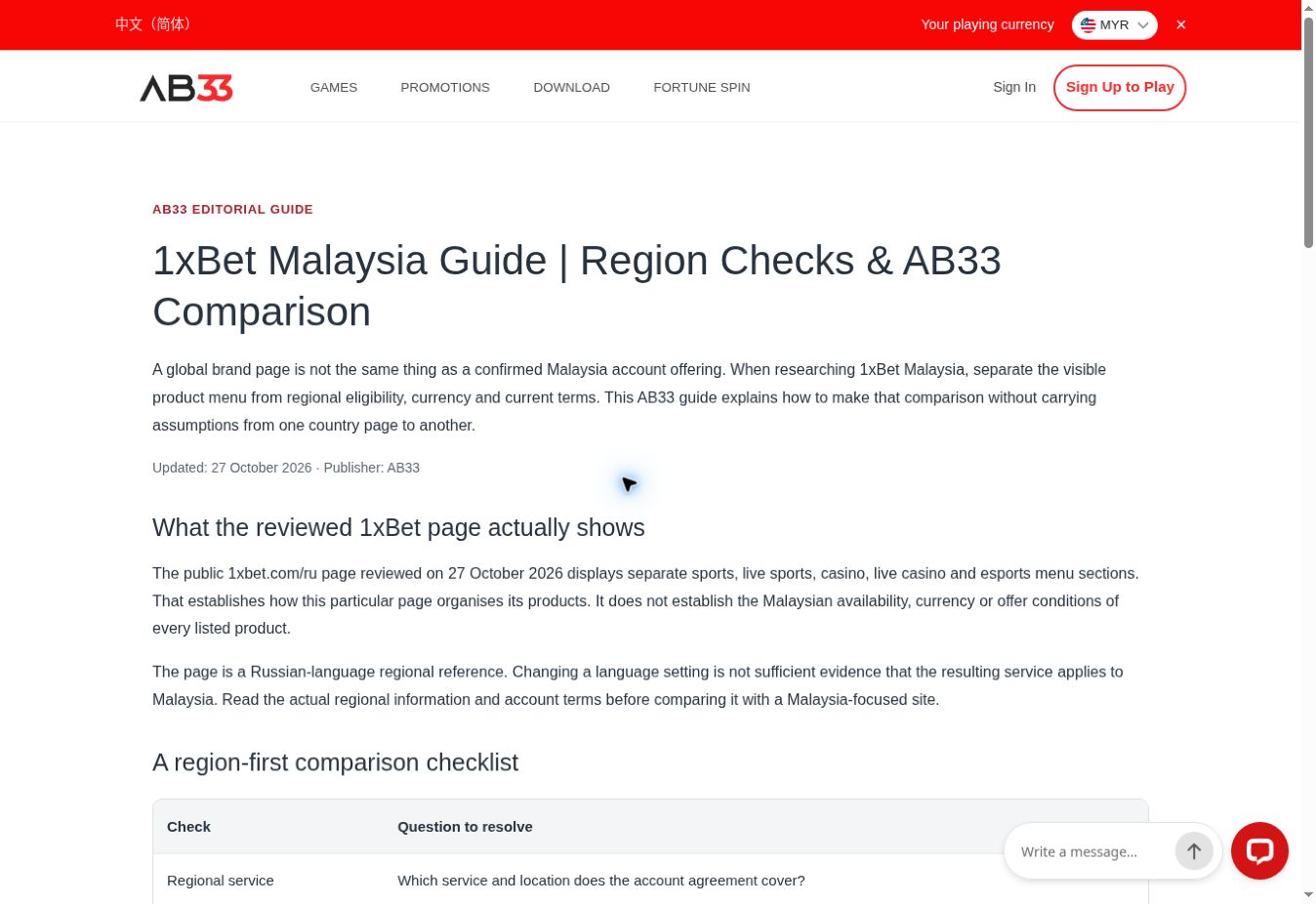
Screenshot: lower section of AB33’s 1xBet comparison guide captured 12 November 2026 from https://www.ab33win3.com/1xbet-malaysia-guide.
A sportsbook promotion might apply only to selected leagues, bet types, minimum odds or settlement outcomes. An advertised percentage is not an alternative to comparing the base market. Read the current written terms, qualifying stake, cap, timing and wagering restrictions. A “refund” or “cashback” headline can describe different mechanisms, including net losses, eligible stakes or a limited offer. Never describe a bonus as universally available on the strength of an old screenshot.
The same caution applies to multi-bets. Adding more selections can make a return appear larger while reducing the chance that the whole slip wins. A promotion should not encourage a reader to stake more than their planned entertainment budget. Set the limit before browsing odds and do not increase it to recover a previous loss.
For each platform, write down the verified domain, region and currency, exact event, market and rule, timestamp of displayed odds, accepted bet slip terms and support route. This record can be reproduced; a claim that one site has “the best odds” cannot be assessed without those details. If you publish a review, date the observations and disclose any commercial relationship to a brand whose pages you link.
The more useful conclusion may be that a particular market is unclear or unavailable, not that another brand has automatically won. Good sports coverage helps a reader understand the bet and the service before money moves. If gambling no longer feels like entertainment, step away and seek independent support rather than searching for another offer.
There is also a distinction between a sportsbook’s own event feed and a score site or social post. A score update can be delayed or corrected, while the operator’s settlement follows its documented official data source and market rules. If you are reviewing an unusual result, preserve the accepted bet slip, market wording and final settlement record before asking support. Do not publish another customer’s betting slip or personal details as proof. For an editorial article, a screenshot of the public menu illustrates navigation; a claim about settled outcomes would require separate, verifiable evidence. Keeping those levels of evidence apart makes the comparison more credible to readers who have never used either platform.
Before comparing prices, review how decimal, Hong Kong, Malay and Indo odds represent the same probability. Then check how the site explains postponed, suspended and abandoned events, because settlement rules can change the practical result.