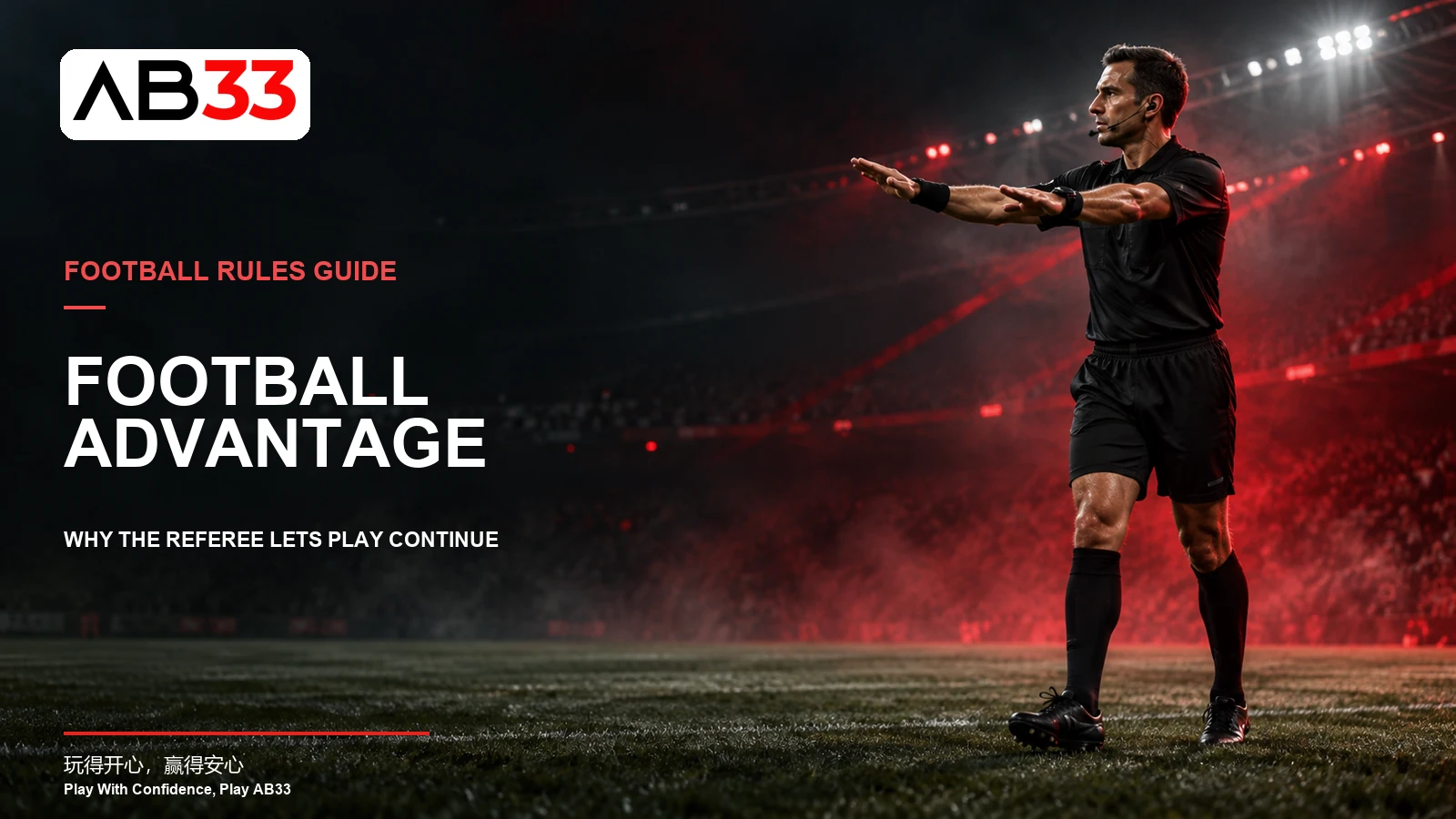
A referee can recognise an offence and still let football continue when doing so benefits the team that was offended against. This is advantage. The explanation below follows IFAB’s 2026/27 Laws, checked on 7 October 2026.
Why the whistle sometimes waits
Stopping play immediately can remove an attacking opportunity. Imagine a midfielder being tripped just after releasing a pass, while a teammate receives the ball with space to advance. The referee may allow that opportunity to develop rather than award the free kick straight away.
The decision belongs to the referee. It does not mean the challenge was lawful or that a player must fall to receive a foul. The authority to apply advantage comes from Law 5.
When play is stopped, the nature of the offence controls the restart. Our companion explanation of direct and indirect free kicks shows why the referee’s signal matters.
What counts as a useful advantage?
Retaining possession is only part of the picture. The referee considers where the offence occurred, the possibility of an immediate promising attack, the seriousness of the offence and the atmosphere of the match.
A controlled pass to an unmarked teammate near goal may offer a clear benefit. A loose ball that leaves the same team surrounded by opponents may not. These are illustrations of the judgment involved, rather than a fixed formula based on how many passes follow the foul. IFAB lists the considerations in its guidance for match officials.
Can the referee return to the foul?
Yes. If the expected advantage fails to appear immediately or within a few seconds, the referee can penalise the original offence. That short assessment period is part of Law 5.
There is no guaranteed goal attached to an advantage. Once a genuine opportunity has developed, a later poor pass or missed shot does not automatically earn the team another attempt through the original free kick.
Why a yellow card can appear later
Advantage can postpone disciplinary action until the ball next goes out of play. A reckless tackle can still deserve a caution even when the attack continues. The referee deals with that misconduct at the next stoppage.
However, a caution solely for stopping or interfering with a promising attack is not given when advantage restores the attack. These are different reasons for punishment. A viewer should ask whether the card is for the tackle’s recklessness or for its tactical effect, rather than assume every delayed yellow card follows the same rule. See Law 12.
Two important 2026/27 clarifications
IFAB expressly allows advantage after an incorrectly taken restart when the ball is in play and continuing benefits the opponents. For instance, an improperly taken throw-in may deliver possession to the other team in a useful attacking position.
The laws also change the disciplinary outcome for denying an obvious goal-scoring opportunity, often shortened to DOGSO. If advantage is played and produces a goal for the non-offending team, there is no card for the DOGSO offence. If the advantage develops without a goal, the DOGSO sanction is a caution. Separate misconduct, such as a reckless challenge, still matters. See the 2026/27 changes.
When safety and sending-off offences take priority
For serious foul play, violent conduct or a second cautionable offence, advantage should only be applied when there is a clear opportunity to score. The offender must then be sent off at the next stoppage. If that player intervenes again by playing the ball or challenging or interfering with an opponent, the referee stops play and sends them off. Under Law 12, the restart is an indirect free kick unless a more serious offence requires another outcome.
Restart situations need their own checks. Our throw-in guide explains when an incorrectly taken restart can still benefit the opponents. If play stops because the ball contacts a match official, consult the dropped-ball possession rules before treating the decision as ordinary advantage.